In This Article
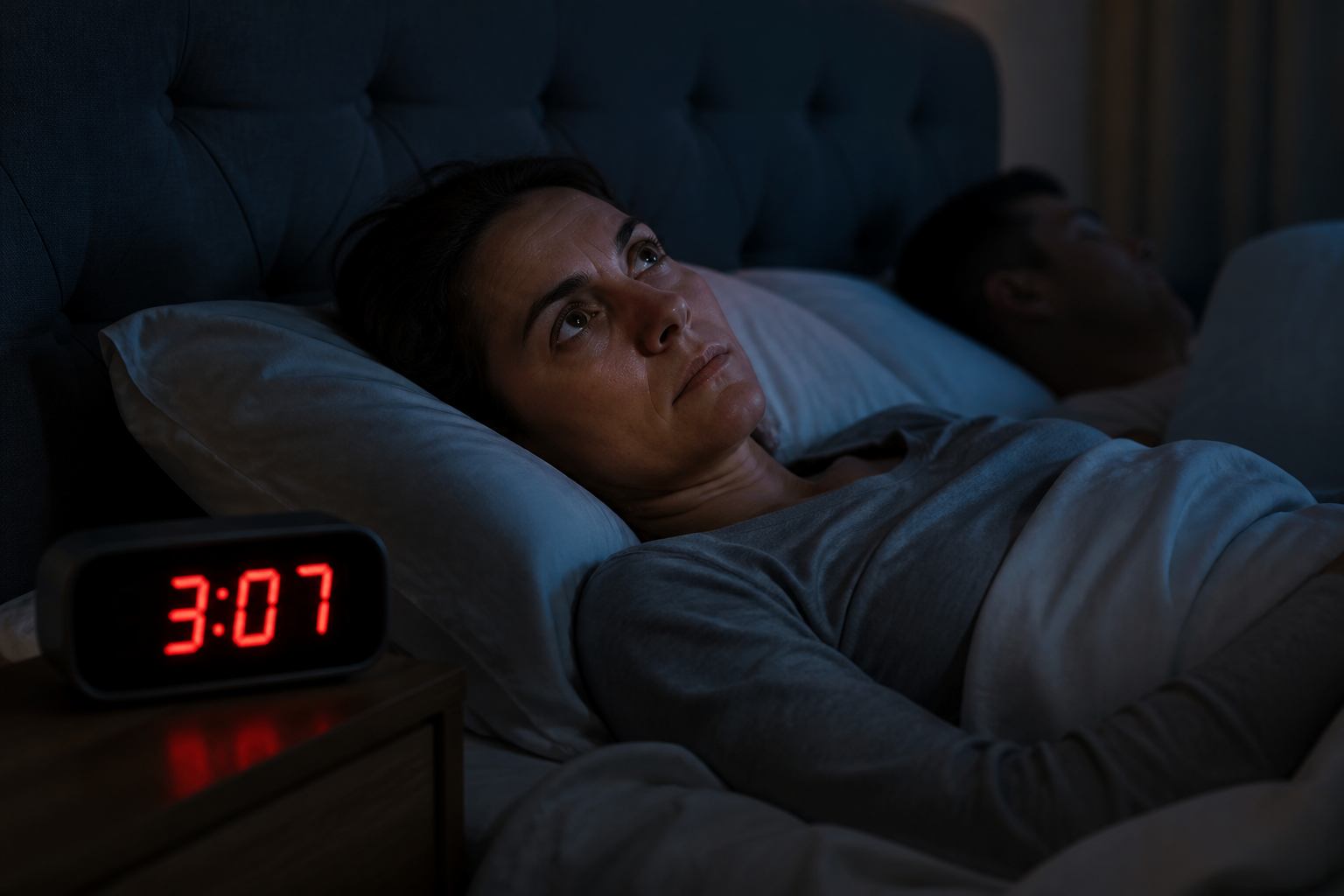
3:07. You know without looking, because it is always roughly now — this exact hollow of the night, your eyes open to the ceiling and your mind already at full sprint, as though it had been waiting politely for you to arrive. The email you should not have sent. The appointment you have not booked. The money. The thing your mother said. The strange fact of mortality, arriving fourth on the list as if it were routine agenda.
Beside you, someone sleeps the sleep of a person whose brain honours office hours. You do the math you always do — if I fall asleep right now I can still get four hours — and the math, as always, makes it worse.
Here is what I want you to know before the next 3:07: this wake-up is not random, it is not a haunting, and it is not a verdict on your life. It is two well-understood mechanisms stacking on top of each other — one biological, one psychological — and both of them are workable.
Key takeaways
- Early-morning waking coincides with the natural overnight rise of cortisol — a stressed system overshoots the surfacing that everyone does
- Night-time panic about your life is daytime anxiety that never got processing time
- Trying harder to sleep is the one strategy guaranteed to fail; getting up briefly is the counterintuitive fix
- The durable repair happens in daylight: reduce the unprocessed load and the nights follow
The biology of the 3 a.m. wake-up
Sleep is not a single unbroken dive. It runs in cycles of roughly ninety minutes, and between cycles everyone — everyone — surfaces briefly. Most of the time you cross these checkpoints without recording them. But two things change the odds in the small hours.
First, the architecture shifts: the deep, heavy sleep is front-loaded into the first half of the night, so by 3 a.m. you are cycling through lighter stages where waking is easier. Second, your cortisol — the mobilising hormone that gets you out of bed — begins its scheduled pre-dawn climb somewhere in those early morning hours. In a calm system, the climb is gentle and you sleep through it. In a system already running hot from months of stress, the baseline is elevated and the climb overshoots. The result is less like drifting awake and more like being switched on: heart a little fast, mind instantly loud, body inexplicably ready for a threat that has not materialised.
So the clock consistency that feels so eerie — why always 3? — is just arithmetic: your sleep cycles plus your cortisol curve, intersecting at the same checkpoint nightly. Worth ruling out as well, with your doctor: alcohol (which reliably fractures the second half of the night), sleep apnea, thyroid issues, and — for women in their forties especially — the hormonal shifts of perimenopause, which are notorious for exactly this wake-up.
The worry you postponed all day
Now the psychological half, which explains not why you wake but why the waking is loud.
Consider what your days actually look like. Alarm, phone, breakfast logistics, commute, meetings stacked like cordwood, messages answered in the gaps between other messages, dinner, the second shift of chores or childcare, and then the evening's great modern anaesthetic — a screen — until your eyes give out. Notice what is missing: any interval in which your mind is permitted to think its own thoughts. Every anxious signal your system raised during the day got the same reply: not now.
But worry is not cancelled by postponement; it is queued. And 3 a.m. is the first appointment slot with genuine availability — no meetings, no phone, no noise, no defence. The mind does not choose the worst possible hour to raise your unresolved life. It chooses the only hour you left open. In that sense the 3 a.m. session is almost obedient: you said not now all day, and it took you at your word.
This is why the busiest, most competent people — the ones running what I have described elsewhere as high-functioning anxiety — are so overrepresented among 3 a.m. wakers. Daylight competence defers the reckoning. It does not delete it. People deep in burnout know this pattern intimately: too exhausted to stay awake at 10 p.m., too activated to stay asleep at 3.
Why everything feels catastrophically worse at night
The worries that visit at 3 a.m. are usually the same ones available at 3 p.m. What changes is the courtroom. In the middle of the night, your prefrontal cortex — the part of the brain that supplies proportion, context, and we handled this before — is underpowered, while the threat system is comparatively loud. Whatever comes up is therefore tried without defence counsel. The work email becomes a career verdict. The odd body sensation becomes a diagnosis. A quiet marriage becomes a failing one.
Add the darkness, the silence, the aloneness of being the only one awake, and the math-of-remaining-sleep panic, and you have a perceptual distortion field as reliable as a funhouse mirror. The single most useful sentence to keep on the nightstand: I am not thinking right now; I am anxious right now, and 3 a.m. me does not get a vote on my actual life. Every decision, verdict, and catastrophic forecast can be re-heard at noon, in front of a fully staffed brain. They almost never survive the appeal.
What to do tonight
First, do not fight for sleep. Sleep is the one performance that flees the effort to produce it; "trying harder" floods the system with exactly the arousal that prevents it. If you have been awake around twenty minutes, do the counterintuitive thing: get up. Leave the bed. Keep the lights low, keep the phone wherever it is, and do something profoundly boring — a dull book, slow stretching, folding laundry in lamplight. Return to bed when drowsiness actually arrives. This is stimulus control, a core piece of CBT for insomnia, and its logic is simple: a bed where you lie awake wrestling becomes, through repetition, a wrestling ring. You are re-teaching your brain what the bed is for.
While you are up, give the racing thoughts a container instead of a debate: two minutes with a notepad — not journalling, just a list. Email. Appointment. Money. Mom. The list is a receipt; it tells the mind the items are logged and the night shift can end. Then a long-exhale breath pattern — exhale slower than the inhale, several minutes — which is the most direct lever a human has on the alarm system at that hour.
And the anti-list, because these quietly maintain the problem: no clock-checking (turn it around), no sleep-math, no phone (the light and the feed both vote for waking), no scrolling "how much sleep do I need" at 3:40 a.m. — that particular search is the insomnia equivalent of googling your symptoms, and it ends the same way.
If 3 a.m. has become a standing appointment, the fix starts in daylight. Book a free 15-minute consultation — daytime slot, naturally.
Fixing the night by treating the day
Here is the reframe that changes the project entirely: chronic 3 a.m. waking is rarely a sleep problem. It is a daytime anxiety problem that has been rescheduled to the only free hour. Which means the durable repair does not happen at night at all.
In therapy, that work has three layers. We reduce the queue — processing the actual load of worry, resentment, grief, and unmade decisions that your days keep deferring, so less of it books the night slot. We retrain the wake-up itself — changing your relationship to the surfacing so that waking briefly becomes a non-event rather than the opening bell of a three-hour session. And where the night alarm is fed by something older — a period of crisis, a loss, a season of hypervigilance your body never stood down from — we address the source directly, sometimes with EMDR, because a nervous system still guarding against the past does its most dedicated guarding at night.
Clients are often surprised by which changes move the needle: not the herbal teas or the expensive mattress, but a decision finally made, a conversation finally had, a boundary finally set. The night is downstream of the day. Clean the river upstream and the water clears where you sleep.
Everything here is available virtually, from wherever in Canada you and your ceiling have been holding your nightly meetings. The evidence for treating anxiety and insomnia this way holds up well online — and there is something fitting about solving the 3 a.m. problem without adding a commute to your day.
Frequently Asked Questions
Why do I always wake up at the same time every night?
Sleep runs in roughly ninety-minute cycles with brief natural surfacings between them, and cortisol begins its scheduled rise in the early morning hours. A stressed system surfaces harder at the same checkpoint night after night. The eerie clock consistency is arithmetic, not an omen.
Why does everything feel so much worse at 3 a.m.?
Because the brain's proportion-and-context department is underpowered in the middle of the night while the alarm system is loud. Worries get tried without defence counsel. The 3 a.m. verdicts are not more honest than the daytime ones — they are less resourced, and they rarely survive a noon appeal.
Should I stay in bed and try harder to fall back asleep?
No. Effort is the enemy of sleep. After about twenty minutes awake, get up, keep the lights low, do something genuinely boring, and return when drowsy. Lying there wrestling teaches your brain that the bed is a wrestling ring, and it learns fast.
Is waking at 3 a.m. a sign of an anxiety disorder?
Occasional early waking is universal and unremarkable. A pattern of waking with racing thoughts, dread, or a pounding heart several nights a week — particularly alongside daytime worry you keep postponing — points to anxiety that deserves attention. The encouraging part: it responds very well to treatment.
Can therapy really fix middle-of-the-night waking?
Yes, and mostly by treating the day. Night waking is usually daytime anxiety cashing a deferred cheque. Therapy shrinks the unprocessed load, retrains your response to the wake-up, and applies CBT-informed sleep strategies — a combination with strong evidence behind it. Persistent snoring, gasping, or unrefreshing sleep also warrants a medical check for sleep apnea.
This post is for educational purposes and is not a substitute for professional mental health or medical advice. Persistent sleep problems can have medical causes worth assessing with your doctor. If you are in crisis or thinking about suicide, please call or text 9-8-8 (Suicide Crisis Helpline, Canada), available 24/7.
Related Reading
- High-Functioning Anxiety: When Your Achievements Are Masking Your Distress
- Burnout Recovery: Why Rest Alone Will Not Heal It — and What Therapy Actually Does
- Perimenopause and Anxiety: What Is Happening in Your Nervous System — and How Therapy Helps