In This Article
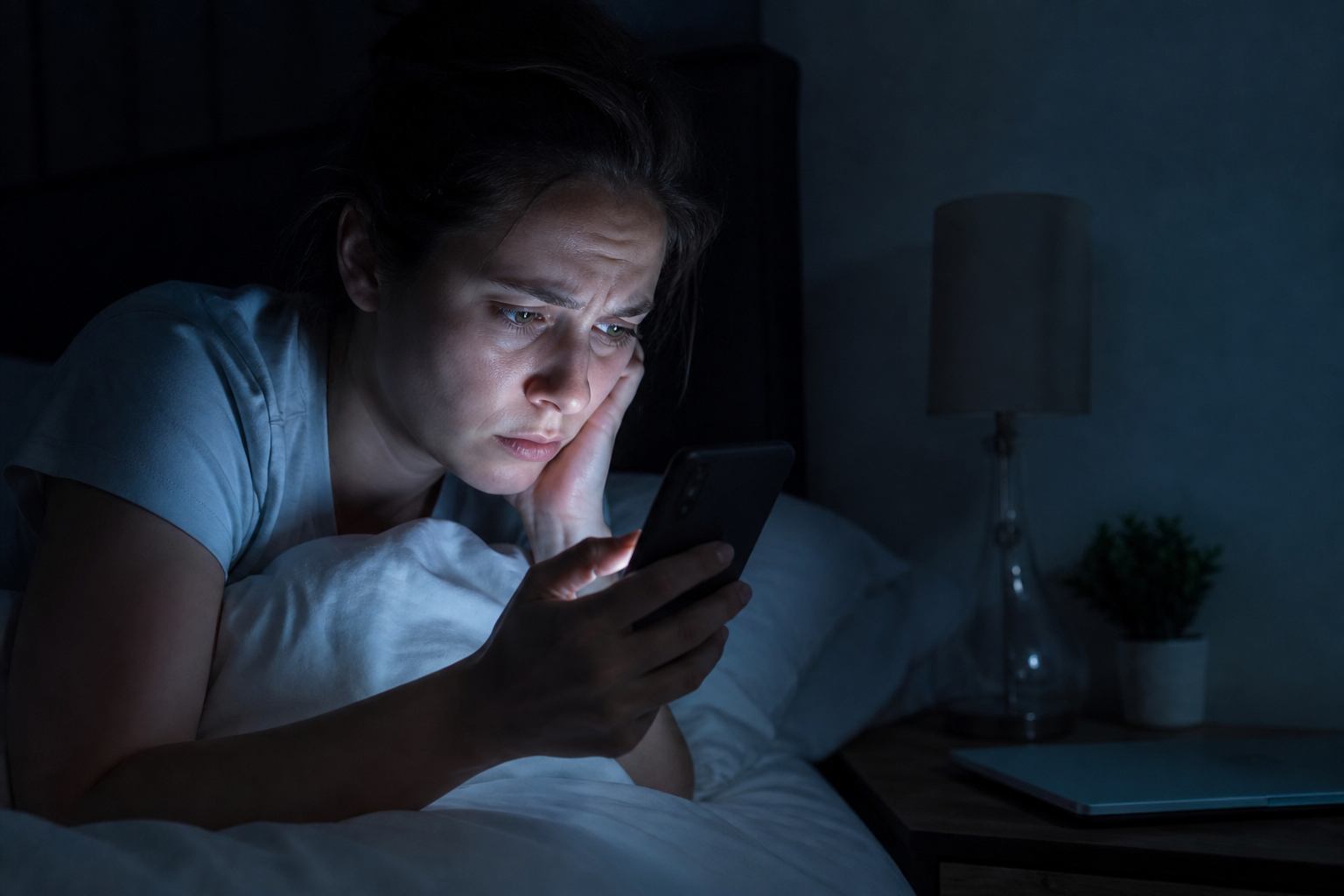
It starts with a sensation. A flutter in your chest while you are washing dishes, a headache that sits differently than usual, a small mark you do not remember being there. Reasonable people notice these things and move on. You open a browser.
Forty minutes later you are eleven tabs deep, reading a forum post from 2014 by someone whose symptoms started exactly like yours, and your body — which was fine an hour ago — is now producing the very tightness and tingling you are reading about. You check the sensation again. Still there. Maybe stronger. One more search, just to settle it. You will not sleep well tonight, and some part of you already knows that next week a different sensation will start the whole sequence over.
If this is familiar, you are not dramatic, broken, or "a hypochondriac." You are stuck in one of the most well-documented loops in clinical psychology — one that modern search engines and symptom-checker apps are almost perfectly engineered to tighten.
Key takeaways
- Health anxiety is a checking-and-reassurance loop, and every search feeds it — even the searches that end well
- Anxiety produces genuinely physical symptoms, which the loop then reads as evidence
- Reassurance has a shrinking half-life; uncertainty tolerance is the actual skill to build
- Therapy works on the loop itself, not on winning an unwinnable argument with your body
The loop that runs your evenings
Health anxiety has a simple architecture with a cruel efficiency. A sensation triggers a thought — what if this is the serious thing? The thought triggers fear. Fear demands resolution, and checking promises it: search the symptom, prod the spot, take your pulse, ask your partner if it looks worse, book the appointment, re-read the old test results. Checking delivers a hit of relief. And relief, in the brain's ledger, is a reward — which quietly teaches the whole system that the fear was valid and the checking saved you.
So the loop runs again, sooner, on less provocation. What began as an occasional search becomes a nightly ritual. The threshold for "worth checking" drops until nearly any signal from the body qualifies. Researchers have a name for the digital version — cyberchondria — and the pattern they document is consistent: symptom searching does not resolve health worry; it escalates it, because the internet is a machine for surfacing the rare and terrifying. A search engine does not know base rates. It does not tell you that the overwhelming majority of headaches are just headaches. It ranks pages by engagement, and nothing engages like the worst case.
Why reassurance never lasts
Here is the observation that surprises people most: a clean test result usually buys a person with health anxiety somewhere between a few days and a few weeks of peace. Then the doubt returns wearing a new outfit. But that was last month. But they didn't scan the other side. But what if the lab made a mistake?
This is not a flaw in your reasoning. It is what anxiety does with reassurance: metabolises it and comes back hungrier. The problem was never a lack of information — you have more health information than any generation in history. The problem is an intolerance of uncertainty so acute that the mind treats "almost certainly fine" as an open case. And medicine, honestly practised, can never give you the thing the anxiety is actually demanding, which is a guarantee. No doctor can promise you will not get sick. The demand itself is the disorder's engine.
This is also why loved ones get exhausted. The tenth "you're fine, I promise" lands with a fraction of the force of the first, and the asking has usually migrated from conversation to compulsion. If your reassurance-seeking has started straining your relationships, that is not a character judgment — it is a sign the loop has outgrown home remedies.
The symptoms are real — that is precisely the trap
The dismissal people fear most is "it's all in your head," so let me be exact: the sensations are in your body. Anxiety is one of the most physical experiences a human can have. It tightens chest walls, speeds and skips heartbeats, produces dizziness through changed breathing patterns, sends tingling into hands and face, disrupts digestion, and generates aches through sustained muscle bracing. Every one of those is a real, measurable, physiological event.
The trap is attribution. The anxious mind feels a real sensation and assigns it a catastrophic cause. Then hypervigilance takes over: once you are scanning your body for trouble, you find signals that were always there — the ordinary noise of a living body that healthy attention filters out. You have effectively turned up the gain on your own interoception. More signal, more fear, more scanning. The body becomes an instrument the anxiety plays.
The physiology of that alarm state — and how it can be retrained — is something I describe in polyvagal theory and the nervous system. The short version: a system taught to expect threat will keep producing threat responses until it is taught otherwise. Teaching it otherwise is a skill, and it is learnable.
Where health anxiety comes from
Almost nobody develops health anxiety at random. In practice I see a handful of recurring origins. A genuine medical scare — yours, or one you watched up close — that ended physically but never got processed emotionally. A parent who died of something that was caught late, leaving you the unspoken job of catching it early. A childhood where illness was the reliable route to care and attention, or where a caregiver's anxiety about bodies was the water you swam in. A health system where long waits teach you that if you do not advocate loudly and early, nobody will — a lesson many Canadians have internalised in the years since the pandemic, and one that makes the vigilance feel less irrational than it looks from outside.
When there is a specific memory at the root — a diagnosis conversation, an emergency, a bedside — EMDR is often the tool, because no amount of logic dissolves an alarm that a memory keeps recharging. Processing the memory cuts the power line.
If your evenings keep disappearing into the search bar, that is reason enough to talk. Book a free 15-minute consultation — no test results required.
What therapy does differently
Therapy for health anxiety does not argue with you about whether you are sick. That argument is unwinnable and beside the point. Instead we work on the loop itself.
That means mapping your personal checking economy — searches, body scans, reassurance requests, appointment patterns — and then reducing it deliberately, in an order you choose, while building the capacity to feel a sensation and not act on it. This is exposure and response prevention, the most evidence-supported approach for health anxiety, and it is far more compassionate in practice than it sounds on paper: we go at the pace your nervous system can actually learn at. Alongside it we work on uncertainty tolerance — the radical, freeing project of living well inside "probably fine" — and, where a memory started all this, we process it directly.
What changes first, usually, is the evenings. The sensation arrives, and there is a pause where the search used to be. Then the pause gets easier. People do not stop caring about their health — they return to sensible care, screenings and checkups included, minus the nightly tribunal. The attention you spent auditing your body comes back to you, and it is startling how much of it there was.
All sessions are virtual, held from wherever you are in Canada, and the research on virtual therapy for anxiety presentations is consistently strong. There is a certain fittingness to treating a screen-fed problem through a screen — this time with the screen on your side.
Frequently Asked Questions
Is health anxiety the same as hypochondria?
Hypochondria is the older, stigmatised name. Current diagnostic language distinguishes illness anxiety disorder from somatic symptom disorder, but most people sit somewhere along a spectrum of health-focused worry. The label matters far less than the loop — and the loop is treatable at any intensity.
But what if something really is wrong with me?
Sensible medical care always comes first: see your doctor, do the age-appropriate screening. Health anxiety is what remains after appropriate reassurance — when a clear result buys days of relief instead of lasting peace. That gap between the evidence and the fear is the treatable part.
Why do I feel real physical symptoms if it is anxiety?
Because anxiety is physical. Chest tightness, skipped beats, dizziness, tingling, stomach trouble — all produced by real mechanisms. The symptoms are not imagined; they are misattributed. Treatment retrains the attribution, and the symptoms themselves quiet as the alarm settles.
Does deleting the symptom-checker apps actually help?
Reducing friction helps at the margins, but health anxiety adapts — it will use forums, AI chatbots, or the archive of your own memory instead. Lasting change comes from retraining your response to uncertainty, not from blocking one outlet for checking while the loop finds another.
What therapy works best for health anxiety?
Cognitive behavioural approaches with exposure and response prevention carry the strongest evidence. Where a real medical event — yours or a loved one's — seeded the pattern, EMDR can process that memory so it stops recharging the alarm. Often the work combines both.
This post is for educational purposes and is not a substitute for professional mental health or medical advice. New, changing, or unexplained physical symptoms should be assessed by a physician. If you are in crisis or thinking about suicide, please call or text 9-8-8 (Suicide Crisis Helpline, Canada), available 24/7.
Related Reading
- Panic Attack vs Anxiety Attack: A Therapist Explains the Difference (and Why It Matters)
- TikTok Diagnosed You. Now What?
- EMDR Isn't Just for PTSD: 9 Things It Can Help With